CU Boulder Energy Master Plan Study Guide
This study guide provides a comprehensive overview of the University of Colorado Boulder’s 2021 Energy Master Plan (EMP). It is designed to facilitate a deep understanding of the university’s strategic approach to energy efficiency, emissions reduction, and long-term sustainability.
Part 1: Short-Answer Quiz
Instructions: Answer the following questions in two to three sentences based on the provided source context.
- What is the overarching role of the Energy Master Plan (EMP) at CU Boulder?
- What specific commitment did the Chancellor make in the April 2021 “Call to Climate Action”?
- How does the University intend to measure and track the success of its energy conservation efforts?
- Describe the current energy consumption profile of the campus in terms of fuel sources and primary usage.
- What are the financial benefits of following the EMP roadmap compared to taking no action or delaying implementation?
- What is the “black-start” capability, and why is it relevant to the West District Energy Plant (WDEP)?
- Explain the relationship between the Energy Services Organization (ESO) and the Energy Action Group (EAG).
- Why does the EMP advocate for calculating Energy Use Intensity (EUI) at a building typology level rather than as a single campus-wide number?
- How do the energy goals of the City of Boulder and the State of Colorado intersect with the University’s plan?
- What are the primary challenges identified in the roadmap that might hinder the University’s transition to a decarbonized system?
——————————————————————————–
Part 2: Answer Key
- What is the overarching role of the Energy Master Plan (EMP) at CU Boulder? The EMP serves as a framework and implementation roadmap for a financially sustainable energy program over the next 30 years. It articulates a vision focused on energy efficiency, greenhouse gas reductions, and a reliable energy supply to support the University’s core mission of education and research.
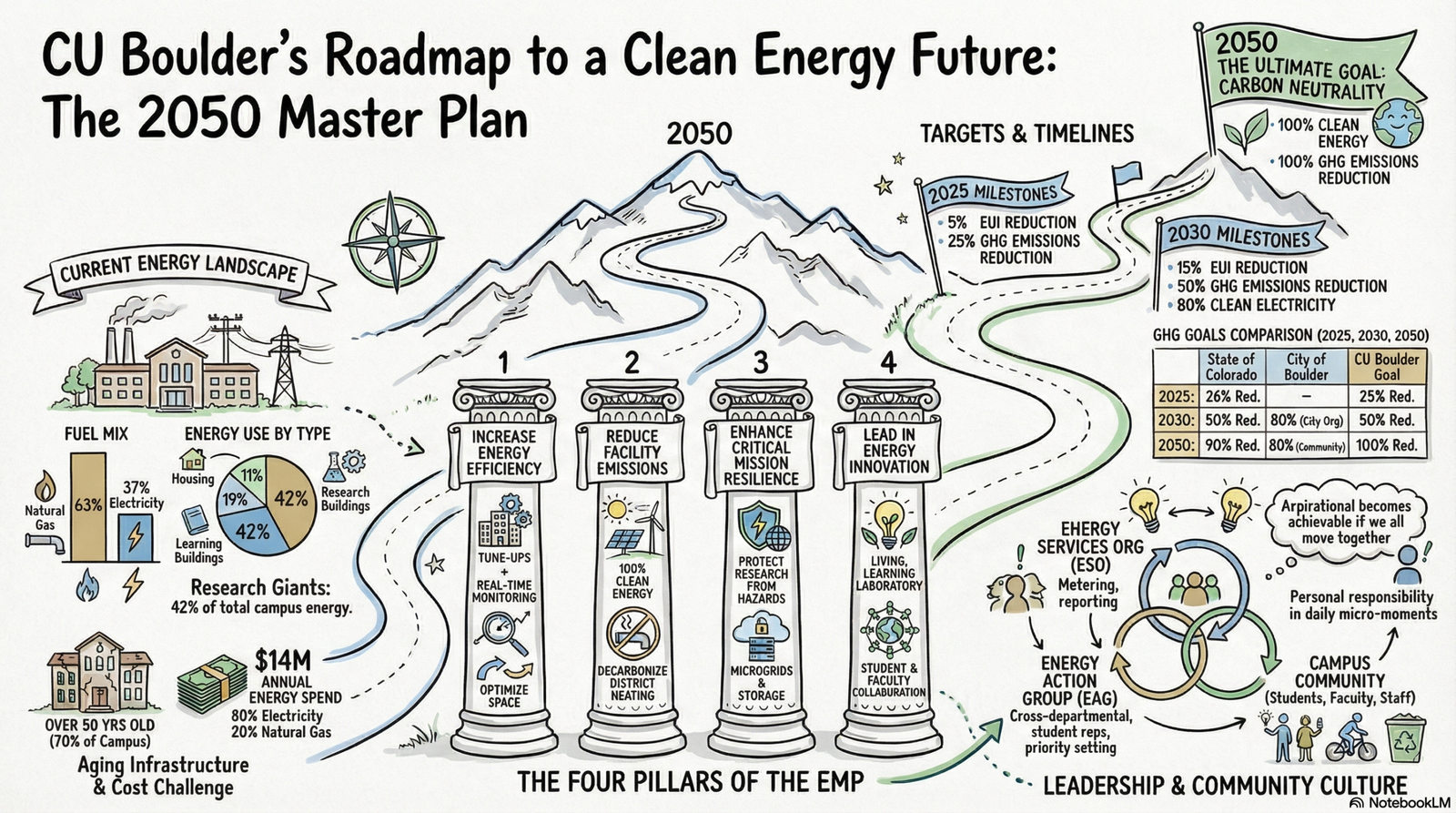
- What specific commitment did the Chancellor make in the April 2021 “Call to Climate Action”? Chancellor Philip DiStefano committed the University to achieving carbon neutrality by no later than 2050. This commitment is supported by the EMP’s goals to reduce energy use intensity and transition to 100 percent clean energy use.
- How does the University intend to measure and track the success of its energy conservation efforts? Success is measured primarily through Energy Use Intensity (EUI) reduction targets, aiming for a 30 percent reduction by 2035 from a FY20 baseline. The University will also utilize annual performance scorecards for individual buildings and track total consumption across various building typologies and stakeholder groups.
- Describe the current energy consumption profile of the campus in terms of fuel sources and primary usage. CU Boulder consumes approximately 1.4 million MMBtu annually, with 63 percent derived from natural gas and 37 percent from electricity. Space heating is the dominant end-use, accounting for 61 percent of total energy demand, followed by research-related process and plug loads.
- What are the financial benefits of following the EMP roadmap compared to taking no action or delaying implementation? The EMP roadmap is projected to realize approximately $100 million in cumulative energy cost savings over the next 30 years compared to a status quo scenario. Conversely, the University estimates that a mere five-year delay in implementing these strategies would cost over $6 million.
- What is the “black-start” capability, and why is it relevant to the West District Energy Plant (WDEP)? Black-start capability allows a power system to restart its operations independently after a failure without relying on an external power grid. The WDEP’s 33 MW cogeneration system currently lacks this capability, which represents a critical vulnerability if external electricity feeders from Xcel Energy are disrupted.
- Explain the relationship between the Energy Services Organization (ESO) and the Energy Action Group (EAG). The ESO is an independent organization that manages the campus energy portfolio and provides technical expertise, while the EAG is a collaborative body of representatives from various campus departments. The ESO coordinates the EAG’s activities and supports individual “Campus Energy Teams” in identifying and scaling energy conservation opportunities.
- Why does the EMP advocate for calculating Energy Use Intensity (EUI) at a building typology level rather than as a single campus-wide number? A single campus-wide EUI would be skewed upward by the growth of energy-intensive research facilities, masking efficiency gains made elsewhere. By measuring EUI by building type (e.g., research, housing, learning), the University can more accurately capture performance improvements through conservation across its diverse portfolio.
- How do the energy goals of the City of Boulder and the State of Colorado intersect with the University’s plan? Both the City and the State have established aggressive GHG reduction targets and clean energy mandates, such as the Colorado Climate Action Plan and the City’s quest for 100 percent renewable electricity by 2030. These regional initiatives provide a collaborative environment and a shared imperative for the University’s own decarbonization and efficiency goals.
- What are the primary challenges identified in the roadmap that might hinder the University’s transition to a decarbonized system? The University faces significant hurdles including a high reliance on a natural gas-fueled steam district heating network and an aging building portfolio with a substantial backlog of deferred maintenance. These issues complicate infrastructure retrofits and require a multi-phased approach to compete for limited capital funds.
——————————————————————————–
Part 3: Essay Format Questions
Instructions: Use the Source Context to develop detailed responses to the following prompts.
- The Nexus of Resilience and Sustainability: Analyze how the EMP views the relationship between energy security and climate action. How do strategies like on-site generation and microgrids serve both the University’s research mission and its environmental commitments?
- Organizational Change and Campus Culture: Discuss the importance of stakeholder engagement in the EMP. Explain how the proposed organizational structure (ESO, EAG, and Campus Energy Teams) aims to foster a “university-first mindset” and a “culture of efficiency.”
- Infrastructure Transition Strategies: The document describes the transition to a decarbonized heating system as a “monumental endeavor.” Detail the role of the District Energy Systems (WDEP and EDEP) in the current plan and the proposed multi-phased approach to addressing their carbon intensity.
- Economic and Strategic Planning: Evaluate the EMP as a financial and planning tool. How does the plan reconcile the need for capital investment in energy systems with the challenges of deferred maintenance and projected campus growth?
- Leadership and Community Integration: CU Boulder aims to “lead by doing.” Examine how the University positions itself as a leader in sustainability within the wider context of the State of Colorado and the global community.
——————————————————————————–
Part 4: Glossary of Key Terms
| Term | Definition |
| ACUPCC | American College and University Presidents’ Climate Commitment; a pledge to achieve carbon neutrality and advance climate research. |
| Black-start | The ability of a power generation facility to restart without relying on an external electric power transmission network. |
| Cogen (Cogeneration) | A system that simultaneously generates electricity and useful thermal energy (like steam) from a single fuel source, such as natural gas. |
| District Energy System | A network of hot water, steam, or chilled water pipes used to provide heating and cooling to multiple buildings from a central plant. |
| EAG (Energy Action Group) | A group composed of representatives from campus organizations that coordinates policy, priority setting, and communication for energy goals. |
| ESO (Energy Services Organization) | An independent campus body responsible for management, oversight, and reporting of the University’s energy portfolio. |
| EUI (Energy Use Intensity) | A metric representing energy use per square foot (kBtu/sf), used to compare the energy efficiency of different buildings regardless of size. |
| GHG (Greenhouse Gas) | Gases like CO2 that contribute to the greenhouse effect; the EMP tracks these in metric tons of carbon dioxide equivalent (MTCO2e). |
| kBtu | Thousand British thermal units; a standard unit of measure for energy consumption. |
| LEED | Leadership in Energy and Environmental Design; a green building certification program (e.g., Platinum, Gold). |
| MMBtu | Million British thermal units; used to express the total annual energy consumption of the campus. |
| Resilience | The ability of campus infrastructure to maintain mission-critical energy needs during natural or human-caused disruptions. |
| Typology | The classification of buildings based on their primary use (e.g., Research, Learning, Housing), used for more accurate energy benchmarking. |
| Xcel Energy | The regional utility provider that supplies both electricity and natural gas to the CU Boulder campus. |